 +49 211 540747 030
 info@kuemago.com
Blog
Repair Case Study: Troubleshooting a Pneumatic Hand Pump with Pressure Loss
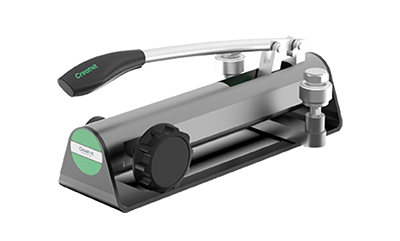
Pneumatic Hand Pump Repair Case Study
Last week, a customer sent us a pneumatic hand pump for repair after experiencing unstable pressure during operation. This case provided a good opportunity to review common failure causes and share practical maintenance insights.
In this article, I’d like to document the repair process and some lessons learned, which may be useful for users and maintenance engineers.
Problem Description
The reported issue was:
When operating the pressure lever, pressure could be built up momentarily, however, after each stroke the pressure quickly dropped, the pressure could not be maintained. In short, the pump could not hold pressure.
Initial Diagnosis
Based on experience, my first judgment was that the problem was related to the check valve near the compression piston.
In a pneumatic hand pump:
- The piston compresses air.
- The check valve prevents backflow.
- If the valve cannot close properly, compressed air will leak back, causing pressure loss.
Therefore, a faulty or contaminated check valve was the most likely cause.
Disassembly and Inspection
This hand pump uses a purely mechanical structure, which makes disassembly relatively simple.
After opening the pump, several issues became clear:
- Heavy contamination inside the air circuit
- Oil stains and rust traces on metal parts
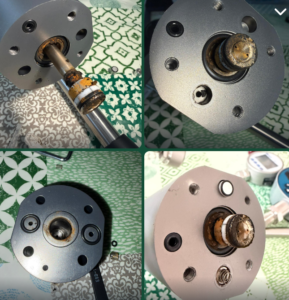 Polluted sealing rings and piston surfaces
The pump uses ambient air as the pressure medium, which is drawn in through a small intake hole. Therefore, contamination can only come from two main sources:
1) From the Tested pressure gauge
The pump has two pressure ports:
- One for the reference (standard) gauge
- One for the device under test
During routine calibration, different test gauges are connected repeatedly. If a tested gauge contains oil, moisture, or dirt, these contaminants can enter the pump system through the pressure port.
2) From Moisture in Compressed Air
When air is compressed, moisture may condense inside the system. Over time, this moisture can cause corro
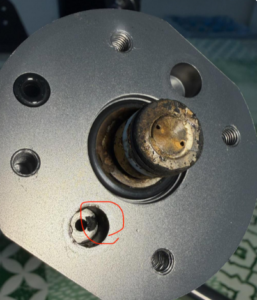
sion and further contamination.
Root Cause
After careful inspection, I found the key problem:
- A small black foreign particle was stuck at the check valve seat.
- This particle prevented the valve from fully closing.
- As a result, compressed air leaked back after each stroke.
This single contaminant was enough to cause the entire pressure instability.
Repair Process
The repair steps were as follows:
- Remove the foreign particle from the check valve
- Clean the entire air circuit thoroughly
- Remove oil residues and rust traces
- Clean and inspect sealing rings and piston surfaces
- Reassemble all components
- Perform functional testing
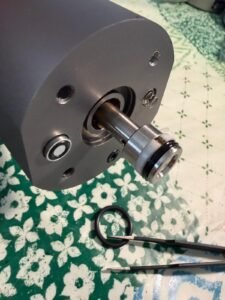
After reassembly and cleaning, the hand pump operated normally again and was able to maintain stable pressure.
Preventive Recommendations
Based on this repair case, I would like to share several practical suggestions:
1) Keep hand pump and Environment Clean
Always ensure that both the working environment and tested instruments are clean and dry. Avoid connecting gauges that may contain oil or moisture.
2) Check Interfaces Regularly
Before connecting a pressure gauge, inspect the interface for dirt, oil, or corrosion.
3) Use an Air/Oil Separator
Installing an air-oil separator between the tested instrument and the pump can effectively prevent contamination from entering the system.
4) Perform Periodic Maintenance
Regular internal inspection and cleaning can greatly extend the service life of hand pumps and maintain measurement reliability.
pressure-hand-pump-check-valve-contamination
Conclusion
This case shows that even a small contaminant can cause serious performance issues in mechanical pressure equipment. Fortunately, with proper diagnosis, cleaning, and maintenance, most problems can be solved efficiently.
By keeping the system clean and following good operating practices, users can significantly reduce downtime and improve long-term reliability.
If you have similar issues or questions about pressure equipment maintenance, feel free to contact us.
Q1: Why does a pneumatic hand pump lose pressure?
Answer: Usually caused by contaminated check valves, worn seals, or internal leakage.
Q2: How often should a pressure hand pump be cleaned?
Answer: It is recommended every 6–12 months or after contaminated gauge testing.
Q3: Can oil damage pneumatic calibration pumps?
Answer: Yes. Oil and moisture can block valves and damage seals.