+49 211 540747 030
 info@kuemago.com

Blog
Spring Diaphragm as a Measuring Element in Pressure Gauges
Introduction
In mechanical pressure measurement, selecting the right sensing element is critical to achieving accuracy and long-term stability. While Bourdon tube systems dominate many applications, they are not always ideal for low-pressure ranges.
For these scenarios, the spring diaphragm offers a fundamentally different approach — acting not just as a barrier, but as the primary measuring element itself.
What Is a Spring Diaphragm?
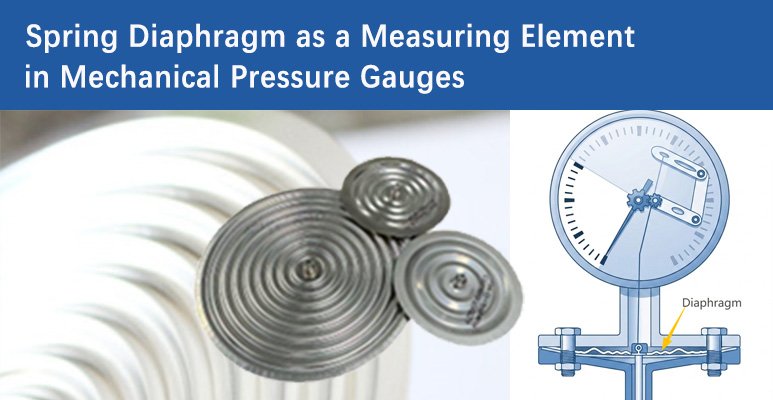
A spring diaphragm is a precision-formed metallic diaphragm designed to deform elastically under pressure. Unlike conventional isolation diaphragms, it directly converts pressure into mechanical displacement.
This displacement is transmitted via a central linkage mechanism to drive the pointer of the gauge.
In other words:
- Isolation diaphragm → transmission only
- Spring diaphragm → measurement + transmission
This distinction is essential.
Why It Is Not Comparable to Isolation Diaphragms
It is important to clarify that a spring diaphragm is not a substitute for an isolation diaphragm.
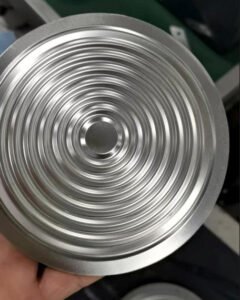
Precision spring diaphragm for mechanical pressure gauges
Isolation diaphragms are typically used:
- To protect internal components
- To separate aggressive media
- To transmit pressure via fill fluid
They are part of a system that may still rely on a Bourdon tube or other sensing structures.
In contrast, a spring diaphragm:
- Eliminates intermediate transmission media
- Acts as the core sensing component
- Requires strict control of material and geometry
The two serve different engineering purposes and are not interchangeable.
Key Performance Requirements
Because the diaphragm itself defines measurement accuracy, several parameters become critical:
- Elastic modulus stability
- Pressure linearity
- Repeatability
- Fatigue resistance
Even small deviations in forming can lead to measurable errors in output.
Manufacturing Complexity
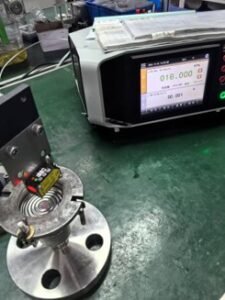
Displacement linearity test of diaphragm
Producing a high-quality spring diaphragm is significantly more demanding than manufacturing standard diaphragms.
The forming process typically involves:
- Multi-step forming cycles
- Controlled rotation of the tooling between steps
- Optimization of concentric corrugation geometry
- Final heat treatment to stabilize material properties
This ensures that:
- Corrugations are evenly distributed
- Radial symmetry is maintained
- Mechanical response is consistent across cycles
Such processes directly contribute to higher cost — often an order of magnitude above standard isolation diaphragms.
Typical Sizes and Market Characteristics
Unlike isolation diaphragms, which come in a wide range of sizes, spring diaphragms are typically standardized: Ø75 mm or Ø130 mm, this reflects their niche but specialized application field.
The primary users are:
- Mechanical pressure gauge manufacturers
- Industrial instrumentation companies
Especially in regions such as: Germany/Italy/France
When to Use a Spring Diaphragm
Spring diaphragms are particularly suitable when:
- Measuring low pressure ranges
- High sensitivity is required
- Mechanical simplicity is preferred over electronic sensing
- Long-term stability is critical
Opportunity in Supply Chain
With changes in the European supply landscape — including the exit of established manufacturers — there is increasing demand for reliable alternative sources.
For instrument manufacturers, this creates both:
- Risk (supply gaps)
- Opportunity (new partnerships)
Conclusion
The spring diaphragm represents a specialized but essential solution in mechanical pressure measurement. Its role as a direct sensing element makes it fundamentally different from conventional diaphragm technologies.
For manufacturers seeking precision in low-pressure applications, understanding this distinction is key to selecting the right design approach.
Looking for a reliable European supply alternative?
Discuss your application with our engineering team.
Related products:
GSD Spring Diaphragm for Pressure Gauge
GCD Isolated Diaphragm for Pressure Sensor
Products in this article
- GFD Isolation Diaphragm for Diaphragm Seals
Designed for diaphragm seals 30+ standard sizes available Multiple corrosion-resistant materials Precision formed diaphragm profile OEM…
- GBD-GTD-GDD Diaphragm Capsule
Precision sensing element For low pressure and vacuum gauges Phosphor bronze or SS 316L Standard diameters:…
- GSD Spring Diaphragm for Pressure Gauge
Core elastic measuring diaphragm Excellent bidirectional linearity High repeatability and stability Stress-controlled heat treatment Diameters: 68mm,…