 +49 211 540747 030
 info@kuemago.com


Leak Testers
Showing all 4 resultsSorted by latest
Leak testing: which measurement principle do you need?
Every leak test answers one question: how much escapes in a given time? The instrument you need depends less on the part than on how the leak shows up — as a pressure drop in a closed volume, as a flow through an open part, or as a pressure rise in an evacuated chamber.
Four measurement principles cover almost all production testing. The table maps each one to the conditions it suits and to the MSF instrument that implements it.
| Principle | How it measures | Best for | Less suitable for | Instrument |
|---|---|---|---|---|
| Differential pressure | Part and reference volume are pressurised together; ambient drift cancels out | small leaks, large parts, shops with temperature swings | very open or porous parts | MSF-F115 |
| Direct pressure | Only the part is pressurised; the pressure trace is watched | simple fixtures, large single cavities | very small leaks on thin-wall parts | MSF-M115 |
| Flow | The leak is read directly as a flow rate | open, porous or continuously leaking parts | sealed parts that must hold pressure | MSF-L115 |
| Vacuum + reference tank | Evacuate, then measure the pressure rise | thin-wall or sealed parts that must not see positive pressure | tests that need high test pressure | MSF-X460 |
Three numbers decide the choice
Start with three values: the leak rate you must still resolve (cc/min or Pa·m³/s), the test pressure, and the cycle time your line allows. If the limit sits below about 1 cc/min on a large part, differential pressure is almost always the cheaper route to a stable reading — the price is a reference volume in the fixture. On open parts, flow is the only method that returns a number at all. And if the part must never see positive pressure, vacuum is the only option.
Not sure which one fits? Send us the part, the test pressure and the leak rate you must resolve — we will confirm the principle and the exact type code.
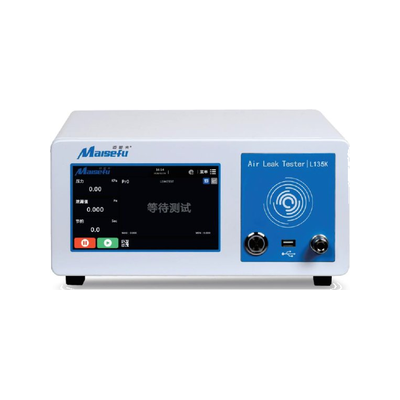
MSF-L135K Flow-Type Air Tightness Tester
Sensor accuracy FS 1 %, range 0.1 - 1000 ml/min
Reads the leak directly as a flow rate - no waiting for pressure decay
For open or continuously leaking parts
Widely used for EV battery packs, motors, controller housings and cooling circuits
7-inch touch screen, 40 parameter sets, RS232 / RS485 / RJ45
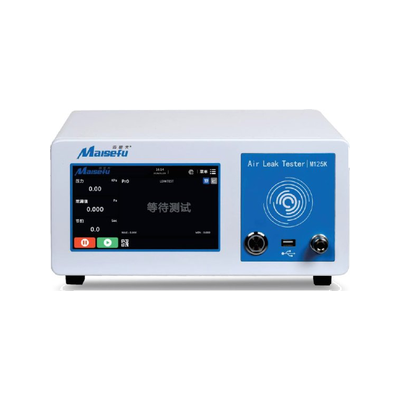
MSF-M125K Direct Pressure Air Tightness Tester
Sensor accuracy FS 0.1 %
In-house pneumatic sealing valve for fast fill and stable readings
Automatic atmospheric zero calibration and temperature compensation
Test pressure 0 - 3500 kPa; driving air 0.4 - 0.8 MPa
Economical and widely used - no reference sample needed
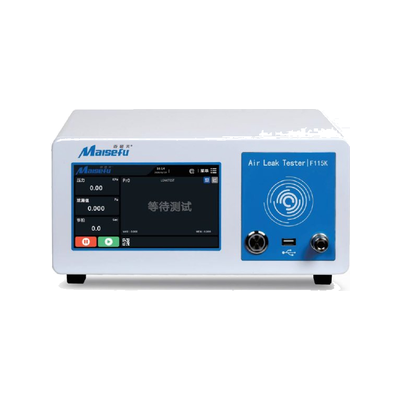
MSF-F115K Differential Pressure Air Tightness Tester
Accuracy up to FS 0.05 %, range ±500 … ±10 000 Pa
In-house high-pressure pneumatic sealing valve for stable readings
Test pressure 0 - 3500 kPa; driving air 0.4 - 0.6 MPa
7-inch touch screen, 40 parameter sets, 128 MB test memory
RS232 / RS485 / RJ45 (Modbus TCP); PROFINET / PROFIBUS optional
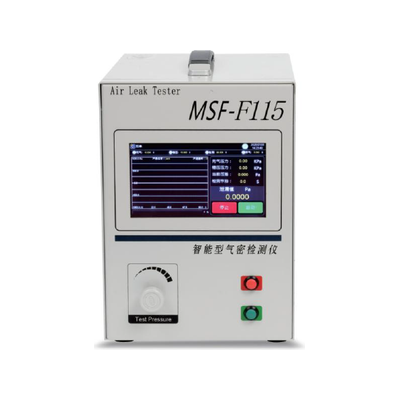
MSF-F115 Differential Pressure Leak Tester
Accuracy up to ±0.05 % FS, range ±500 … ±10 000 Pa
In-house high-pressure shut-off valve for stable readings
7" touch screen, 40 test programs, 30-day data memory
RS232 / RS485 / RJ45 (Modbus TCP), PROFINET / PROFIBUS optional
4 PNP inputs and 4 outputs for fixture integration
Leak Tester for Industrial Pressure and System Testing
Leak testers are test devices used to detect and evaluate leakage in pressure systems, components, and assemblies. They are widely applied in quality control and production testing of sensors, valves, fittings, and sealed components. Depending on the application, leak testers can operate with air, gas, or differential pressure methods to ensure system integrity and reliability.