+49 211 540747 030
 info@kuemago.com

Blog
Differential Pressure Leak Testing Solution

A Compact Process-Grade Solution for OEM Equipment
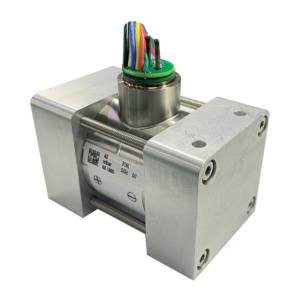
Pressure decay and differential pressure methods are among the most widely used technologies in industrial leak testing. While
both aim to detect extremely small leaks, differential pressure testing is often preferred for automated production lines because it provides excellent repeatability, faster test cycles, and reduced sensitivity to environmental influences.
However, selecting the right differential pressure sensor has long been a challenge.
Many compact MEMS differential pressure sensors offer the required low measurement ranges, but their overload capability and long-term stability can become limiting factors in demanding industrial environments. On the other hand, high-end process differential pressure transmitters provide outstanding performance, yet their size and cost make them difficult to integrate into OEM leak testing equipment.
Our objective was straightforward:
Bring the performance of a process transmitter into a compact sensor module suitable for equipment integration.
Starting with Proven Process Instrumentation Technology
Instead of developing a completely new sensing element, we started with a monocrystalline silicon differential pressure sensor originally designed for premium process instrumentation.
These sensing elements have already been optimized for demanding industrial applications, offering:
- Excellent measurement accuracy
- Outstanding long-term stability
- Wide operating temperature range
- Exceptional mechanical overload capability
Rather than reinventing the sensing technology, we focused on adapting it for compact OEM equipment.
Mechanical Design for Equipment Integration
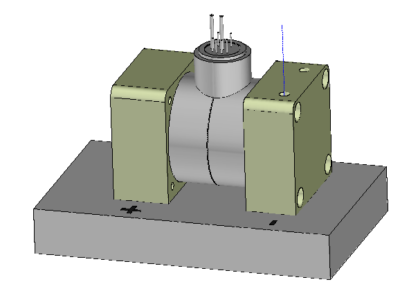
The sensing element itself was only part of the solution.
To make it suitable for leak testing equipment, we developed a dedicated rectangular clamping manifold.
This mechanical structure performs several functions simultaneously:
- Provides secure mechanical clamping for the sensing element
- Connects both pressure ports to the external pneumatic system
- Serves as the mounting interface for the complete sensor assembly
By integrating these functions into a single component, the overall structure becomes significantly more compact while simplifying installation inside automated leak testing machines.
Factory-Calibrated as a Complete Assembly
Unlike supplying only the sensing element, every assembled module is calibrated after final assembly.
The complete sensor undergoes:
- Pressure calibration
- Temperature compensation
- Output linearization
The result is a finished transmitter that can be integrated directly into OEM equipment with a standard 4–20 mA interface.
No additional signal conditioning or sensor compensation is required by the equipment manufacturer.
Why a ±6 kPa Measurement Range?
Leak testing is fundamentally about detecting extremely small pressure differences.
A narrow measurement span of only ±6 kPa allows the transmitter to resolve pressure changes at the Pascal level, even when using the industry’s widely accepted 4–20 mA analog output.
This provides excellent sensitivity without requiring specialized digital interfaces, making system integration straightforward for existing leak testing equipment.
Combining High Resolution with High Overload Capability
One of the unique advantages of this solution comes from the sensing element itself.
Unlike many miniature differential pressure sensors, the monocrystalline silicon sensor adopts a process-transmitter architecture with an internal multi-diaphragm mechanical structure.
This design provides exceptional resistance to static pressure and overload while maintaining excellent sensitivity within a very small measurement range.
As a result, the solution combines two characteristics that are often difficult to achieve simultaneously:
- Pascal-level differential pressure resolution
- Process-transmitter-class mechanical robustness
For OEM equipment manufacturers, this means high measurement performance without sacrificing durability or integration flexibility.
Designed for Modern Leak Testing Equipment
By combining mature process instrumentation technology with a purpose-built mechanical design, this solution offers an alternative to traditional high-cost imported differential pressure sensors.
Rather than compromising between performance and integration, equipment manufacturers can benefit from process-grade sensing technology in a compact, factory-calibrated module designed specifically for leak testing applications.
Leak Testing Solutions Series
Part 1 – Pressure Decay Leak Testing
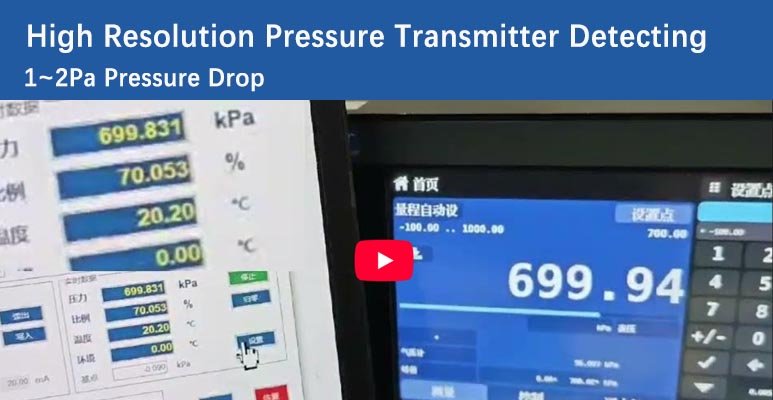
Detecting pressure changes as small as 2 Pa within a 1 MPa pressure range using a high-resolution pressure transmitter.
The GP-6210 High Accuracy Pressure Transmitter provides a practical and efficient solution, combining precision, stability, and industrial robustness in a single device.
Part 2 – Differential Pressure Leak Testing (This article)
Adapting proven process instrumentation technology into a compact differential pressure solution for OEM leak testing equipment.
Products in this article
- GP-6210 High Accuracy Pressure Transmitter
High accuracy: up to ±0.03% FS 3.3ppm high resolution RS485 & 4~20mA double outputs Temperature output…
- GP-2900 Differential Pressure Sensor
Wide range: 0 kPa to 3.5 MPa Static pressure up to 20 MPa Temperature compensated output…