Dead weight tester is one of the most reliable instruments for precision pressure calibration and serves as a primary standard in metrology today. At the core of every deadweight tester lies a highly refined component—the piston unit. Understanding how it works provides valuable insight into how such systems achieve exceptional accuracy.
Inside the Core: Piston and Cylinder
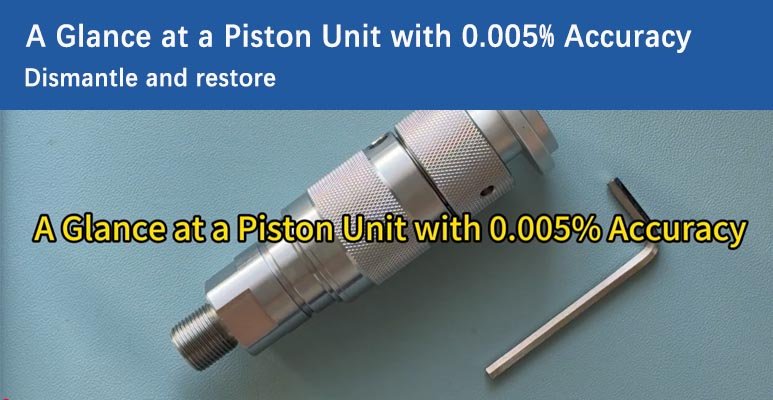
In this demonstration, the piston unit is carefully disassembled to reveal its internal structure. The piston rod can be smoothly withdrawn from the cylinder, showing an extremely tight and controlled clearance between the two components.
This precise fit is not achieved by machining alone. Each piston–cylinder pair is hand-lapped by skilled technicians over several weeks, ensuring superior surface finish and dimensional consistency.
This level of craftsmanship is essential for high-accuracy pressure calibration systems such as a dead weight tester.
The Principle Behind the Precision
The working principle of a deadweight tester is simple:
Pressure = Force / Area
Once the effective area of the piston is precisely defined, pressure can be generated by applying calibrated weights.
By verifying the mass of these weights using precision balances, the system can generate highly accurate and repeatable pressure values—making it suitable for calibration laboratories and industrial reference applications.
Why Precision Matters
The piston unit demonstrated here supports a system accuracy of up to 0.005%, highlighting the importance of mechanical precision in pressure measurement.
Even microscopic deviations in geometry or surface condition would directly affect the effective area—and therefore the generated pressure.
This is why high-end calibration equipment relies on both advanced engineering and skilled manual finishing.
Watch the Process
The video below provides a closer look at the piston unit in operation—from disassembly to the smooth interaction between piston and cylinder.
Building Reliable Calibration Systems
High-accuracy pressure calibration is never the result of a single component. It is the combination of:
Precision mechanical design
Stable pressure generation
Reliable calibration instruments
From piston units to complete systems and supporting tools, each element plays a critical role.
👉 Looking for a complete pressure calibration solution? Contact us to discuss your application and system requirements.
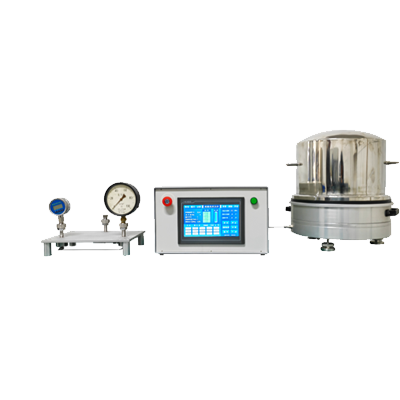
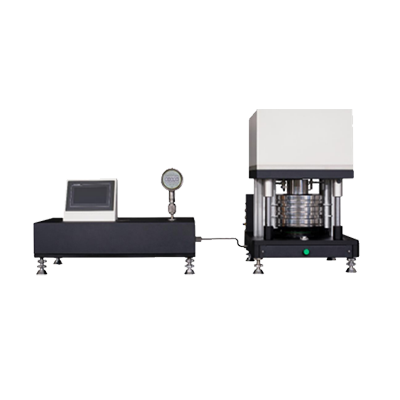
Primary pressure standard with high accuracy
Ceramic & tungsten carbide piston system
Pneumatic automatic weight loading
Fast stabilization with intelligent control
For calibration labs and aerospace industry
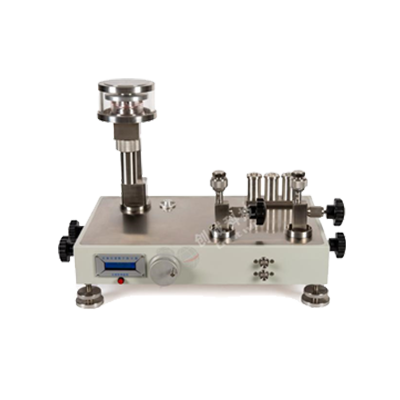
Tungsten carbide piston-cylinder
Single piston for vacuum and pressure
Modular piston, low maintenance
Non-magnetic calibrated weight set
Dual stop valves, leak protection
Fine pressure adjustment, fast stability
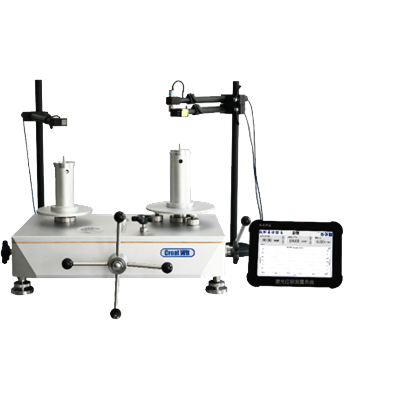
Integrated primary and auxiliary piston system
Tungsten carbide piston and cylinder
Anti-friction, anti-jamming piston structure
Modular piston assemblies, shared base
Laser displacement monitoring, 0.01 mm resolution
Touchscreen visualization and data export
 +49 211 540747 030
 info@kuemago.com
 Components