 +49 211 540747 030
 info@kuemago.com

Blog
A Smarter Way to Build Pressure Transmitters
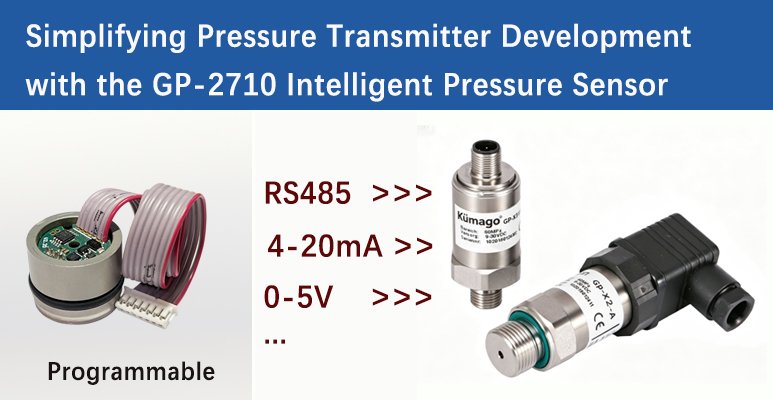
Simplifying Pressure Transmitter Development with the GP-2710 Intelligent Pressure Sensor
Modern pressure transmitters are expected to deliver high accuracy, stable performance, multiple communication options, and reliable EMC protection. However, developing a pressure transmitter from a traditional analog pressure sensor often requires significant hardware design effort, EMC optimization, firmware development, and complex calibration processes.
For many equipment manufacturers and small-volume OEM projects, transmitter development can become time-consuming, expensive, and difficult to standardize.
The GP-2710 Intelligent Pressure Sensor was designed to provide a different approach.
Instead of acting only as a digital sensor, the GP-2710 serves as an intelligent sensing platform that simplifies pressure transmitter development while maintaining high measurement performance.
Limitations of Traditional Digital Pressure Transmitter Development
A conventional pressure transmitter development process usually includes:
- Analog sensor signal conditioning
- MCU development and compensation algorithms
- Temperature compensation
- Nonlinearity correction
- EMC protection design
- Analog output calibration
- Communication protocol integration
- Production calibration equipment
Although this architecture is widely used, it introduces several challenges:
- Long development cycles
- High engineering complexity
- Difficult EMC verification
- Expensive calibration equipment
- Limited flexibility for different output types
- Increased manufacturing and labor cost
In many cases, even small modifications such as changing the output type or communication interface may require redesigning part of the hardware.
From Sensor to Transmitter — A Different Architecture
The GP-2710 introduces a more integrated solution.
Within the standard Φ19 mm OEM pressure sensor form factor, the GP-2710 integrates:
- An onboard MCU
- High-performance signal processing circuits
- Proprietary compensation algorithms
- Digital temperature compensation
- Nonlinearity correction
- Multi-interface communication capability
Unlike traditional ASIC-based digital pressure sensors with fixed functionality, the GP-2710 is designed for flexible system integration and software-based configuration.
The sensor supports:
- RS485 & I2C & SPI
Users can configure the sensor through Modbus communication software, including:
- Operating working mode selection
- Pressure unit switching
- Range scaling
- Address configuration
- Sampling rate configuration
- Offset adjustment
This architecture transforms the sensor from a fixed-function device into a configurable measurement platform.
Rapid Pressure Transmitter Development
To simplify transmitter development, optional interface boards are available for:
- RS485 transmitters
- 4–20mA transmitters
- Voltage-output transmitters
These compact boards already include:
- EMC protection circuits
- Signal conversion circuits
- Industrial power input support
By connecting the GP-2710 sensor directly to one of these interface boards, users can quickly build the core of a pressure transmitter.
This approach significantly reduces:
- Hardware development complexity
- EMC design workload
- Firmware development effort
- Prototype development time
For many applications, this means pressure transmitters can be developed much faster with lower engineering cost.
Flexible Output Configuration
Different industrial systems often require different output standards.
The GP-2710 solution supports:
- RS485 Modbus output
- 4–20mA output
- 0–5V output
- 0–10V output
- 1–5V output
- Other configurable voltage ranges
For customized voltage outputs, some onboard resistor values on the voltage-output board may be adjusted or replaced.
This allows manufacturers to adapt the transmitter to different industrial systems while maintaining a common sensor platform.
Simplified Calibration Process
One of the most practical advantages of the GP-2710 solution is simplified transmitter calibration.
Traditional analog transmitter calibration often requires:
- Precision pressure sources
- High-accuracy pressure controllers
- Dedicated calibration equipment
- Complex production procedures
The GP-2710 uses high-accuracy digital compensation inside the sensor itself, allowing the analog output stage to be calibrated through software.
In many cases, analog output calibration can be completed using:
- A standard multimeter
- Configuration software
This greatly reduces:
- Calibration equipment cost
- Production complexity
- Operator skill requirements
- Manufacturing time
For small and medium-volume transmitter manufacturing, this can provide substantial cost advantages.
Designed for Embedded Integration
The GP-2710 is also suitable for direct embedded integration.
Because the intelligent processing circuitry is integrated inside the standard sensor structure without increasing size, the sensor can be integrated into:
- Portable instruments
- Embedded control systems
- Industrial equipment
- Battery-powered systems
- Smart monitoring devices
The sensor supports:
- Low-voltage operation down to 1.8V
- Low-power standby modes
- Flexible communication interfaces
This makes the platform suitable for modern intelligent instrumentation and industrial IoT applications.
Accuracy and Stability
The GP-2710 supports accuracy levels up to:
- ±0.03% FS (TEB)
The sensor performs:
- Digital temperature compensation
- Nonlinearity correction
- Signal processing inside the sensor
This allows the compact sensor structure to achieve performance levels comparable to many pressure transmitters.
The platform also supports configurable sampling rates:
- 5Hz, 20Hz (default), 50Hz, 100Hz
The default configuration is optimized for stable industrial measurement and noise-resistant operation.
Typical Applications
The GP-2710 transmitter solution is especially suitable for:
- Industrial pressure transmitters
- Embedded measurement systems
- OEM instrumentation
- Hydraulic and pneumatic systems
- Smart monitoring equipment
- Battery-powered devices
- Industrial IoT platforms
- Cost-sensitive transmitter manufacturing
Conclusion
The GP-2710 Intelligent Pressure Sensor provides a new approach to pressure transmitter development.
By integrating intelligent processing, configurable communication interfaces, and optional transmitter interface boards into a compact OEM sensor platform, the solution simplifies hardware development while reducing calibration complexity and manufacturing cost.
Rather than functioning as only a digital pressure sensor, the GP-2710 acts as a flexible sensing platform for modern industrial systems and rapid transmitter development.
As industrial systems continue moving toward smarter, more configurable architectures, integrated intelligent sensing platforms may become an increasingly practical alternative to traditional analog transmitter design.