 +49 211 540747 030
 info@kuemago.com

Blog
Knowledge for better measurement decisions.
Practical insight for the questions that arise between specification and operation.
Five IO-Link Converters, Two Signal Directions
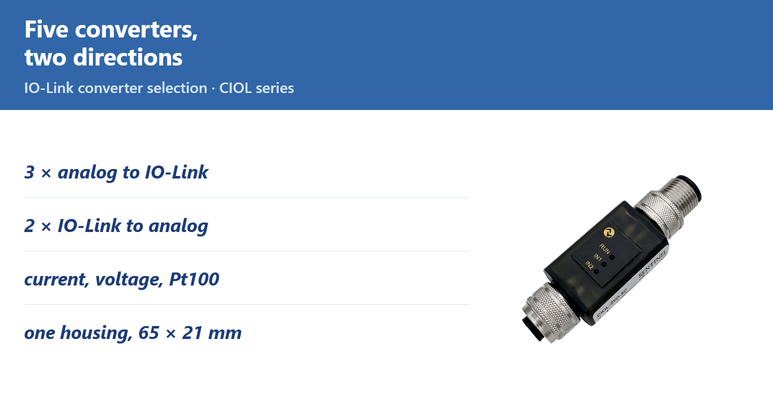
Five CIOL converters share one housing. What changes is the direction the signal travels and the type of signal it carries.
Five part numbers, one housing
All five converters in the CIOL series use the same housing: 65 × 21 mm, transparent, with a status LED. All five reach the IO-Link master through an M12 A-coded port and communicate as IO-Link V1.1, Class A. From the outside they are difficult to tell apart.
For selection that leaves two questions. Which way does the signal travel — from an analog sensor up to the master, or from the master down to an analog device? And what kind of signal is it: current, voltage, or temperature?
Three converters that bring analog signals in
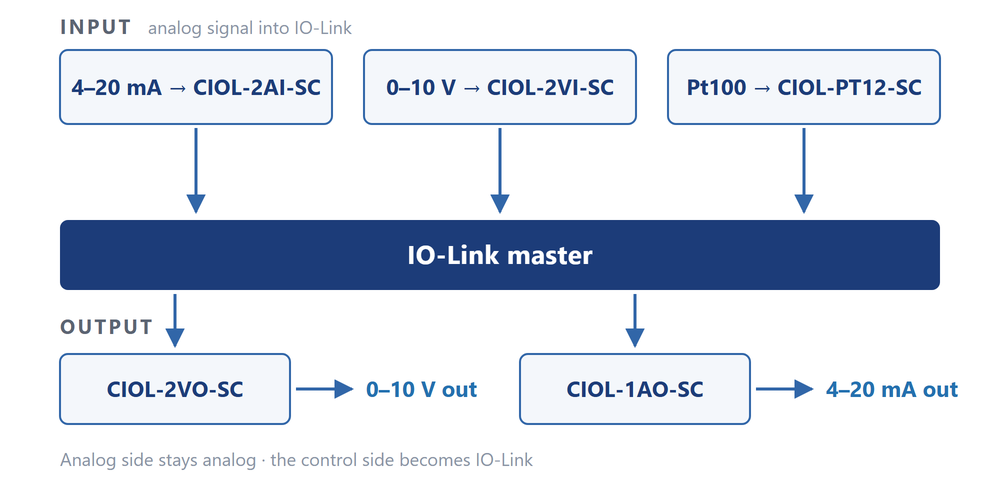
Three models work in the input direction. They read an analog value and hand it to the master as IO-Link process data.
CIOL-2AI-SC takes two current inputs, 4–20 mA or 0–20 mA, on two independent channels, with 0.5 %FS accuracy. This is the model for the common case: a machine already carries 4–20 mA pressure, level or flow sensors and the control architecture is moving to IO-Link.
CIOL-2VI-SC has the same two-channel layout for voltage signals, 0–10 V. It is the choice where the analog sensor or the existing field wiring delivers a voltage output rather than a current loop.
CIOL-PT12-SC has one channel and reads Pt100 resistance thermometers in 2-, 3- and 4-wire connection, over a measuring range of −200…600 °C with ±0.5 °C accuracy. It removes the separate temperature transmitter and the compensation wiring that normally sit between the RTD and the control cabinet: the Pt100 goes straight onto the IO-Link port.
Two converters that take IO-Link back to analog
The remaining two models run the opposite way. The master sends a setpoint; the converter turns it into an analog output.
CIOL-2VO-SC provides two independent 0–10 V outputs. CIOL-1AO-SC provides a single current output, selectable as 4–20 mA or 0–20 mA.
Both exist for the same reason. Frequency inverters, proportional valves, positioners and analog input cards are still specified with analog interfaces. Where a PLC or an IO-Link master has to write a setpoint to such a device, these converters keep the analog device in place while the control side becomes digital. In most retrofit cases the alternative would be an additional analog output card or a gateway.
Side by side
The table lists only what changes between the five models.
| Model | Direction | Channels | Signal | Range or accuracy |
|---|---|---|---|---|
| CIOL-2AI-SC | Analog → IO-Link | 2 | 4–20 mA / 0–20 mA input | 0.5 %FS |
| CIOL-2VI-SC | Analog → IO-Link | 2 | 0–10 V input | 0.5 %FS |
| CIOL-PT12-SC | Analog → IO-Link | 1 | Pt100, 2/3/4-wire | −200…600 °C, ±0.5 °C |
| CIOL-2VO-SC | IO-Link → Analog | 2 | 0–10 V output | 0.5 %FS |
| CIOL-1AO-SC | IO-Link → Analog | 1 | 4–20 mA / 0–20 mA output | 0.1 %FS |
Five situations and the model that fits
A 4–20 mA pressure sensor has to reach an IO-Link master. This is the standard retrofit case, and CIOL-2AI-SC covers it. Two channels mean a second sensor on the same machine can use the spare channel.
The sensor output is 0–10 V. Same layout, different input stage: CIOL-2VI-SC. Check the signal type before ordering, because a voltage input will not read a current loop.
A Pt100 should appear on IO-Link without a transmitter. CIOL-PT12-SC connects 2-, 3- and 4-wire sensors directly. Where the RTD is already installed and only the evaluation electronics are being replaced, the sensor and its cable remain as they are.
The master has to drive a frequency inverter with a 4–20 mA input. CIOL-1AO-SC turns one IO-Link setpoint into one current output. A single channel is enough when there is one drive.
A proportional valve takes 0–10 V. CIOL-2VO-SC supplies two voltage outputs from one port, which covers a valve pair or a valve plus a second analog device.
What stays the same across the family
Housing, supply and interface do not change: 65 × 21 mm transparent housing with status LED, 24 VDC supply drawing under 50 mA, IO-Link V1.1 Class A on M12 A-coded connectors, operating temperature −25…80 °C. ISDU access and parameter storage are supported, so a master can write the parameters back into a replacement device.
Each model has one 4-pin port for IO-Link and one for the analog side. Changing the model within the series therefore leaves the mechanical layout, the space in the cabinet and the M12 cables untouched.
Choosing in three steps
First, decide which side of the link the analog signal is on: sensor side or actuator side. Second, name the signal — current, voltage or Pt100. Third, decide whether one channel is enough.
That is the whole decision. Full specifications for each model are on the IO-Link solutions page, and every model has its own product page with datasheet and drawing. For a specific machine, send us the signal type, the number of channels and the device at the other end, and we will confirm the model.
If the question is instead why a converter is worth using at all, rather than replacing the sensors, the earlier article on bridging analog sensors to IO-Link covers that side.
Products in this article
- CIOL-1AO-SC IO-Link Converter
IO-Link analog output converter Single channel 4–20 mA / 0–20 mA IO-Link V1.1, Class A interface…
- CIOL-2AI-SC IO-Link Converter
Dual-channel 4–20mA / 0–20mA input IO-Link V1.1, Class A interface ≤12-bit resolution, 0.5% FS accuracy M12…
- CIOL-2VI-SC IO-Link Converter
IO-Link analog signal converterDual channel 0–10V inputIO-Link V1.1 Class A interface12-bit analog resolutionM12 industrial connectorsLED status…
- CIOL-2VO-SC IO-Link Converter
IO-Link analog output converter Dual channel 0–10 V output IO-Link V1.1, Class A interface ≤12-bit resolution,…
- CIOL-PT12-SC IO-Link Converter
IO-Link RTD input converter Single-channel Pt100, 2/3/4-wire Measuring range −200…600 °C Accuracy ±0.5 °C IO-Link V1.1,…